Sandusky’s Legacy in Low Budget Horror and Comedy Films
The original 1990’s Sandusky movie makers creating local productions before the digital age.
What is Blade Independent Studio?
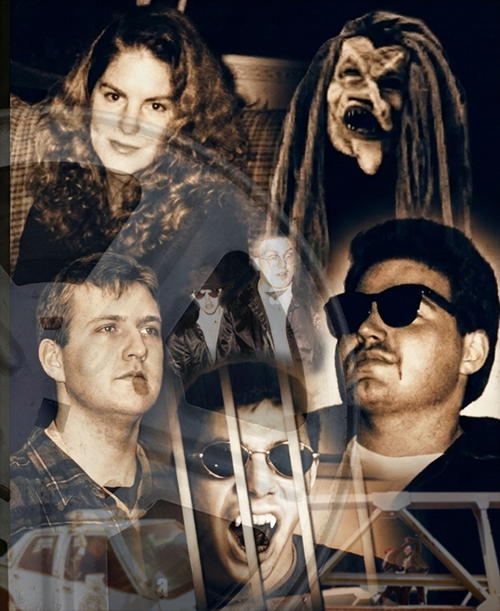
Blade Independent Studio was an independent film company based in Sandusky, Ohio, with a distinctive place in regional horror and comedy history. Between 1989 and 1997, the studio produced nine annual summer feature releases, along with numerous smaller productions and episodic shorts throughout the year. Together, these films created a body of work defined by ambition, atmosphere, and a fiercely independent creative spirit.
Although portions of Blade’s catalog have been lost over time, the studio’s legacy lives on through the Wimp series, A Darker Light, and other surviving productions. These films reflect a raw, inventive approach to independent filmmaking that helped shape the underground genre scene of the 1990s. Rooted in local talent and driven by a passion for storytelling, Blade Independent Studio represents a unique chapter in Ohio film history—one built on resourcefulness, creativity, and a lasting love of horror and comedy.
Most Blade productions were modest in length, typically running around an hour or less, and focused primarily on horror and comedy. Many were written and produced by Lester Daniels and Richard Buathier, while Mark Allen Brown served as editor and director on numerous projects.
Filmmaking Before the Digital Age
Blade Independent Studio began in the mid-1980s using Super 8 film. As video technology became more accessible, production shifted to VHS, with final masters eventually created on Super VHS (S-VHS). This was an entirely analog era, long before digital editing became commonplace.
Editing was performed tape-to-tape, assembling each production into a finished master that could then be duplicated onto VHS for distribution. By the time Blade released its final feature, Wimp Unleashed (1997), DVD technology was just beginning to emerge. Hundreds of VHS copies of Blade films circulated throughout the region during the studio’s active years, well before YouTube, streaming, or social media transformed independent film distribution.
One notable exception came in 2000 with Deadline, produced under the Trance and Zephyr banners by director Mark Brown and writer C. Paul Fuhr. Co-produced by Blade alumnus Lester Daniels and featuring several former Blade collaborators, Deadline was shot on Super VHS but transferred to digital for editing. It represented the group’s first—and ultimately last—venture into digital post-production before the format became the industry standard. The completed film was released on both VHS and DVD.
Featured Summer Releases
Blade’s largest productions were traditionally filmed and premiered during the summer months. Screenings were held at Harlequins Playhouse Theatre, the Radisson Hotel, and other local venues.
While most productions ran around an hour, the studio’s longest films were 1993’s Nativeborn, the sequel to The Natives Are Restless, with a running time of 1 hour and 27 minutes and 1995’s Wimp 2 with a running time of 1 hour and 29 minutes.
Promoting each release was a true team effort. Richard Buathier, in particular, became known for tirelessly spreading the word through every promotional avenue available in the pre-internet world of the 1990s.
Summer Feature Releases
1989 — Cenobium
1990 — Warped
1991 — The Natives Are Restless
1992 — The Evil Eye
1993 — Nativeborn
1994 — Wimp
1995 — Wimp 2
1996 — A Darker Light
1997 — Wimp Unleashed
2000 — Deadline (Produced after Blade Independent Studio’s original run.)
Cast, Crew, and Community
During Blade’s nine-year run, hundreds of local friends, family members, and volunteers contributed to its productions, often appearing in multiple films.
Casting itself became an important part of each production’s promotion. Large scenes frequently featured casts of more than fifty performers, filling bar fights, mob scenes, and crowd sequences with enthusiastic local participants.
The productions also benefited from remarkable community support. Filming locations included local businesses such as Jolly Donut, Country Kitchen, Cinema World, The Drinkery, and the Radisson Hotel, as well as public locations including Osborne Park, the Castalia Quarry, and several area cemeteries.
Producers Lester Daniels and Richard Buathier were equally successful in securing unique production resources, including decommissioned police cruisers and even a semi-truck for ambitious action sequences.
Original Musical Scores
Music played an important role in Blade productions. Most films featured original scores composed specifically for each project, although trailers occasionally incorporated popular music of the era.
Among the local musicians who contributed original compositions were Shawn St. James, Scott Von Heldt, Tony Pulizzi, Brian Runkle, and Patrick Conley. Many of these artists continue to write, record, and perform today, although they are now scattered across the United States.
Their work became an essential part of Blade’s identity, giving each film its own atmosphere and making the original soundtracks significant creative works in their own right.
Preserving the Legacy
An ongoing effort is underway to digitize, restore, and preserve as much of the Blade Independent Studio catalog as possible.
Unfortunately, some original master tapes were permanently lost due to storage accidents, including flood damage. Even so, restoration efforts continue, and this website will be updated as additional films, photographs, promotional materials, and behind-the-scenes history are recovered and preserved.
Final Thoughts
The many contributors to Blade films were passionate people who simply loved the work. This was never about making money; it was about improving our craft. We pooled our money and resources to build production budgets, and every aspect of each project was scripted, organized, and carefully planned.
We didn’t just grab a camera and see what we could film that day. Everyone had day jobs or was attending school, and these productions were what we worked on in our free time. This was what we wanted to be remembered for. Each person had an assigned role and understood the production plan.
Although Richard was known for saying he was “the next big thing,” we all wanted to have fun and create something that was not prominent during that era. With every production, we pushed ourselves to improve and raise the bar for our technical abilities.
There were no Hollywood contracts or mass-distribution deals. The 1980s and 1990s marked the rise of the big-budget Hollywood blockbuster, and we loved that idea. We set out to emulate it on a local level—just without the big budget.
Hats off to everyone who participated and helped create something memorable. The memories are real, and the work remains tangible even after all these years. And as a bonus, we managed to stay out of the police blotters. No easy feat considering the stunts we all pulled to get the shot.
Check out the Split Tooth Media Article Forgotten Ohio: Uncovering Blade Independent Studio and ‘A Darker Light’ (1996)